INDUSTRY NEWS
The differences between center butterfly valve, double eccentric butterfly valve, and three eccentric butterfly valve and their respective applicable scenarios
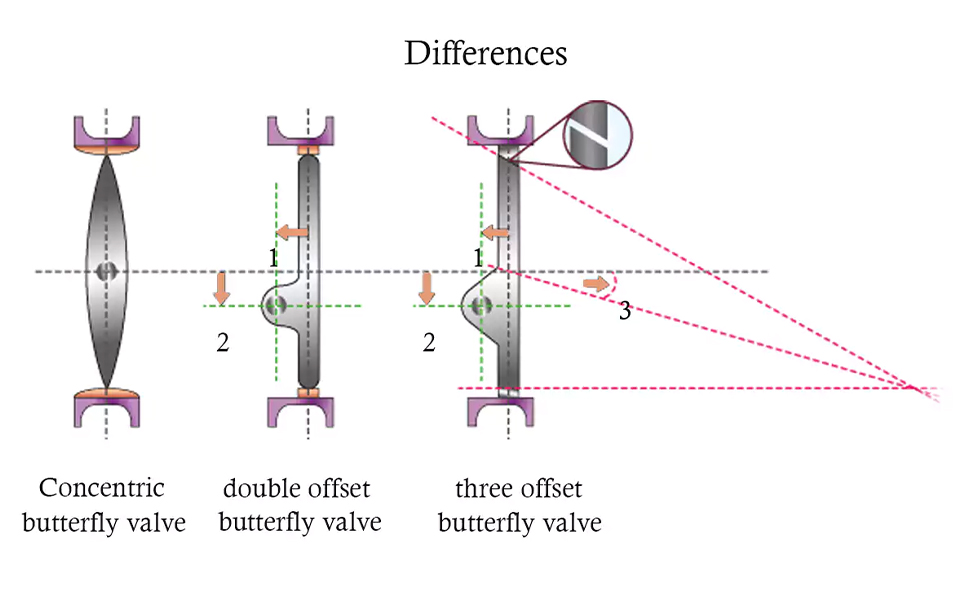
The center butterfly valve, double eccentric butterfly valve, and three eccentric butterfly valve are the three main structural types of butterfly valves. The core difference lies in the relative position design of the valve shaft and the sealing surface (eccentric structure), which directly affects the sealing performance, operating torque, and applicable working conditions. The following is a detailed comparison and applicable scenarios of them:
Center Butterfly Valve (Concentric Butterfly Valve)
Structural characteristics: The valve shaft, butterfly plate center, and valve body center are concentric (no eccentricity). The sealing surface is a soft seal (such as rubber, PTFE), and the sealing is achieved by the butterfly plate pressing against the valve seat.
Advantages: Simple structure, low cost. Good sealing performance (zero leakage at low pressure and normal temperature). Small operating torque, easy to open and close.
Disadvantages: Valve seat is prone to wear, not resistant to high temperature and high pressure. Not suitable for media containing particles or corrosive substances.
Applicable scenarios: Low pressure (PN10 below), normal temperature (≤120℃) water, air, gas, etc. Commonly used in municipal water supply, air conditioning systems, food industry, etc.
Double Eccentric Butterfly Valve (Single Eccentric + Radial Eccentric)
Structural characteristics:
First eccentric: The valve shaft deviates from the center of the butterfly plate (single eccentric), reducing the friction between the butterfly plate and the valve seat during opening and closing.
Second eccentric: The valve shaft deviates from the center of the valve body sealing surface (radial eccentric), achieving quick separation from contact during opening and closing.
The sealing surface is mostly a soft seal or metal hard seal.
Advantages: Smaller opening and closing torque, longer service life. Can adapt to slightly higher pressure and temperature.
Disadvantages: The sealing performance is not as good as that of the three eccentric butterfly valve under high pressure.
Applicable scenarios:
Medium low pressure (PN16~PN25), medium temperature (≤200℃) liquids or gases.
General media in industries such as sewage treatment, chemical engineering, and power.
Three Eccentric Butterfly Valve
Structural characteristics:
The first two eccentricities are the same as the double eccentric (valve shaft deviates from the center of the butterfly plate + radial eccentric).
The third eccentricity: The valve seat sealing surface is inclined at a certain angle (conical eccentric), making the contact between the butterfly plate and the valve seat a line seal.
The sealing surface is a metal hard seal (such as stainless steel, alloy steel).
Advantages: Zero friction opening and closing, extremely small torque, extremely long service life. Resistant to high temperature (≤600℃), high pressure (PN100 above), and corrosive media. Excellent bidirectional sealing performance (can replace gate valves, globe valves).
Disadvantages: Complex structure, high cost. Strict processing accuracy requirements.
Applicable scenarios:
High temperature and high pressure, harsh media (steam, oil and gas, acids and alkalis, etc.). Key systems in petrochemicals, nuclear power, ships, metallurgy, etc.
 +86 15122654356
 +86 15122654356
 sale2@tjlituo.com
 Xiaozhan Industrial Area, Xiaozhan Town, Jinnan District ,Tianjin , China