INDUSTRY NEWS
The Difference Between Butterfly Valves and Gate Valves
Butterfly valves and gate valves are both commonly used valves in the industrial field. They have many differences in terms of structure, working principle, performance characteristics and application scenarios. Here is a detailed introduction for you:
Structure
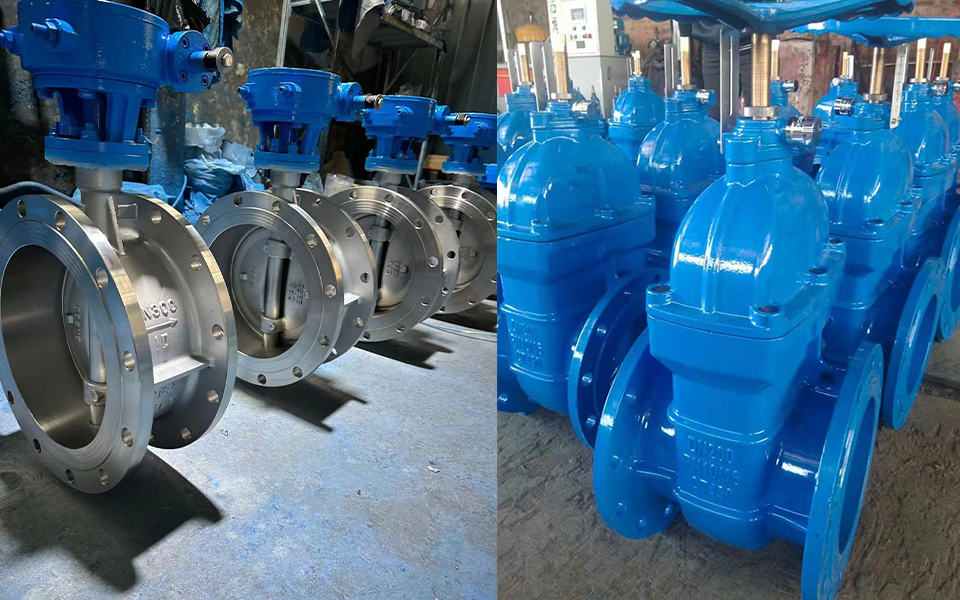
Butterfly Valve: It is mainly composed of the valve body, valve stem, butterfly plate and sealing ring. The butterfly plate is a circular disc that is installed on the valve stem and can rotate around the axis of the valve stem. Its structure is relatively simple and compact, with a small volume and light weight, and occupies less space.
Gate Valve: It is composed of the valve body, valve cover, gate plate, valve stem, etc. The gate plate is the key component for opening and closing the valve, and moves vertically along the center line of the valve seat to achieve the opening and closing of the valve. The overall structure is relatively complex, with larger dimensions and heavier weight.
Working Principle
Butterfly Valve: The flow of the fluid is controlled by rotating the butterfly plate. The rotation angle of the butterfly plate is between 0° and 90°. When the angle is 0°, the valve is closed, and when it is 90°, the valve is fully open. The operation is simple and rapid, and it can be quickly opened and closed.
Gate Valve: The opening and closing of the valve is controlled by the lifting of the gate plate. When the gate plate rises, the valve opens, and when it drops, the valve closes. The opening and closing process is relatively slow.
Performance Characteristics Sealing property
Butterfly Valve: The sealing performance is relatively weak, especially in high-pressure, high-temperature or situations with extremely high sealing requirements. It may cause slight leakage. However, with technological advancements, the sealing performance of some high-performance butterfly valves has significantly improved.
Gate Valve: The sealing performance is good. When fully closed, it can effectively stop the flow of the medium and is suitable for situations with strict sealing requirements.
Flow Resistance
Butterfly Valve: When fully open, the butterfly plate has a relatively small obstruction to the fluid, but there is still some flow resistance, resulting in certain pressure loss.
Gate Valve: When fully open, the gate plate is completely separated from the flow channel, and the fluid is almost not hindered. The flow resistance is small, and the pressure loss is also small.
Regulating Performance
Butterfly Valve: The regulating performance is good. It can precisely control the flow by changing the rotation angle of the butterfly plate and is suitable for situations that require flow regulation.
Gate Valve: It is generally not used for flow regulation and is mainly used for cutting off or connecting the medium. If used in a half-open state, the gate plate will be washed and worn by the fluid, affecting the service life and sealing performance of the valve.
Pressure and Temperature Operating Range
Butterfly Valve: It is usually suitable for medium and low pressure, medium and low temperature situations. The nominal pressure is generally not more than 2.5 MPa, and the working temperature is between -20℃ and 200℃. However, specially designed butterfly valves can also be used in high-pressure and high-temperature environments.
Gate Valve: It can withstand higher pressure and temperature. The nominal pressure range is wide, from low pressure to high pressure (such as 0.1 MPa - 32 MPa), and the working temperature range is also larger, ranging from -200℃ to 600℃. Application scenario
Butterfly Valve: Widely used in fields such as water supply and drainage, air conditioning, ventilation, and environmental protection, it is used to regulate flow and cut off fluids. In some occasions with high requirements for space and weight, such as in ships and construction industries, butterfly valves are more applicable.
Gate Valve: Commonly used in pipeline systems in industries such as petroleum, chemical engineering, and power. It is mainly used to cut off or connect media and is more frequently used in occasions where there is no need for frequent flow regulation, such as large water supply and drainage pipelines, steam pipelines, etc.
 +86 15122654356
 +86 15122654356
 sale2@tjlituo.com
 Xiaozhan Industrial Area, Xiaozhan Town, Jinnan District ,Tianjin , China