INDUSTRY NEWS
Electric valve installation and maintenance should pay attention to what
Installation Notes
Installation Location Selection
1. should be selected to facilitate the operation, maintenance and observation of the location, should be left enough space around the general valve to reserve at least 0.5 meters of space, to facilitate the operation and maintenance of personnel.
2. Avoid installation in the environment with large vibration, high temperature, humidity or corrosive gas. If it cannot be avoided, corresponding protective measures should be taken, such as adding vibration reduction devices, heat shields and moisture-proof boxes.
3. For the horizontal pipeline, the electric valve should be installed on the horizontal pipeline, the valve stem should be vertical upward, special circumstances need to tilt installation, tilt Angle should not exceed 30°, to ensure the normal work of the electric actuator.
Pipe connection requirements
1. before the connection, to ensure that the internal clean pipeline, no debris, welding slag, etc., can be cleaned by compressed air purging or water flushing.
2. The connection between the electric valve and the pipeline should ensure the coaxiality, and the deviation should not exceed the specified value. Generally, the coaxiality deviation is not greater than 2mm to prevent additional stress and affect the sealing performance and service life of the valve.
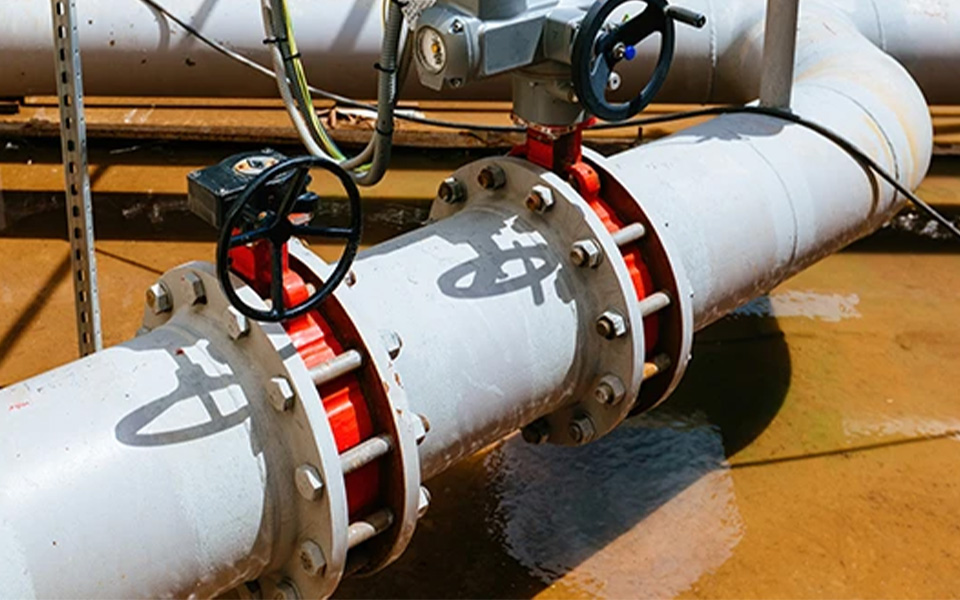
3. When using flange connection, it is necessary to ensure that the flange surface is flat and no deformation, the bolts should be tightened evenly, and the nut 2-3 buttons should be exposed after the bolts are tightened, and the tightening force of each bolt should be uniform and consistent.
Electrical connection points
1. In strict accordance with the wiring diagram of the electric valve, to ensure that the wiring is correct, the terminal should be connected firmly to prevent loose.
2. Access to the power supply should be in line with the rated voltage, frequency and other requirements of the electric valve, voltage fluctuation range should not exceed ±10% of the rated voltage.
3. Must be good grounding protection, grounding resistance should not be greater than 4Ω, to ensure the safety of personnel and equipment.
Installation and debugging Steps
1. After the installation is completed, the first manual operation test, check whether the opening and closing action of the valve is flexible, whether there is no jam, block and other phenomena.
2 And then carry out electric debugging, check whether the opening and closing action of the electric actuator is normal, whether the opening indication of the valve is consistent with the actual opening, and whether the limit switch and the over-torque protection function are reliable.
3. In the debugging process, if any problems are found, they should be solved in time, and it is strictly forbidden to put into operation with faults.
Maintenance Notes
Daily Maintenance points
1. Regularly check the appearance of the valve, including the valve body, stem, electric actuator, etc., to see whether there is corrosion, wear, leakage and other phenomena, if there should be timely treatment.
2. Check the operation status of the valve, such as whether the opening and closing action is normal, whether there is abnormal sound and vibration, and if the problem is found, the machine should be stopped in time for inspection.
3. Keep the electric valve clean, regularly clean the surface of the valve dust, oil and other debris, to prevent it from entering the valve interior, affecting the normal work of the valve.
Regular maintenance project
1. Lubricate the motor, gearbox and other components of the electric actuator regularly. Generally, grease should be added or replaced every 3-6 months to reduce friction and ensure its flexible operation.
2. Check the sealing performance of the valve, which can be detected by means of pressure test and so on. If the sealing performance is found to decline, the seal should be replaced in time.
3. Check the electrical system of the electric valve, including the wiring terminals, contplayers, relays, etc., to see whether there is loosening, ablation and other phenomena, if there should be timely repair or replacement.
Troubleshooting methods
1. When the electric valve fails, first determine whether it is an electrical failure or a mechanical failure. Can check the power supply, motor, control circuit and other aspects to troubleshooting electrical fault; Check the opening and closing action of the valve, the jam situation, the sealing performance and other aspects of the mechanical failure.
2. For common faults, such as the valve can not be opened or closed, it may be caused by power failure, motor failure, limit switch failure or internal card of the valve. It should be gradually investigated to find out the cause of the fault and repair.
3. If there is a complex fault or the cause of the fault cannot be determined, professional maintenance personnel should be contacted in time for maintenance. Blind disassembly and maintenance are strictly prohibited to avoid greater losses.
 +86 15122654356
 +86 15122654356
 sale2@tjlituo.com
 Xiaozhan Industrial Area, Xiaozhan Town, Jinnan District ,Tianjin , China