INDUSTRY NEWS
Can butterfly valves be used to regulate flow?
Butterfly valve is a common industrial valve, its simple structure, small size, fast opening and closing, widely used in fluid pipeline system. For whether it can be used to regulate the flow, the answer is yes, but it needs to be comprehensively considered according to the working condition in the specific application.
Working principle and regulation potential
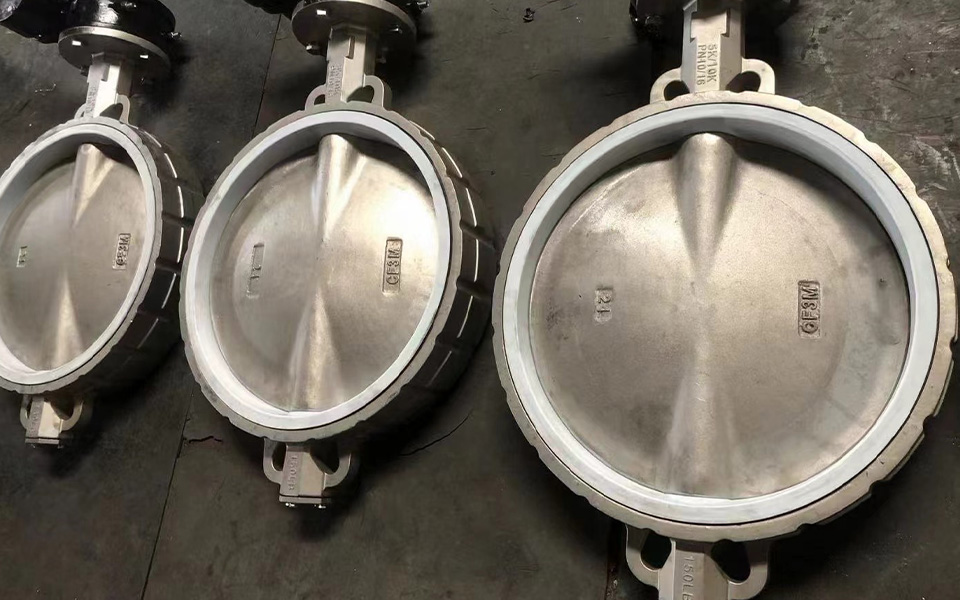
The core adjustment component of the butterfly valve is a disc shaped butterfly plate, which is installed in the diameter direction of the pipe. Driven by the stem, the disc rotates around its axis in the body, usually between 0° and 90°. When the butterfly plate rotates parallel to the pipe axis (0°), the valve is fully open, and the flow path is almost completely unblocked; When it is rotated perpendicular to the pipe axis (90°), the valve is completely closed to achieve truncation. At any intermediate position between 0° and 90°, the butterfly plate will form a "barrier" to the fluid, changing the effective circulation area of the flow channel, so as to realize the throtting and regulation of the flow.
In principle, the butterfly valve has the basic function as a regulating valve. Its flow characteristics are similar to equal percentage characteristics, that is, when the opening degree is small, the change rate of flow is relatively gentle, which is helpful to realize fine adjustment. When the opening degree is large, the flow changes rapidly and the regulation response is fast.
Advantages for regulation
Convenient adjustment and fast response: the butterfly board only needs to rotate a quarter of a circle to complete the action from fully open to fully closed, easy to operate, can quickly respond to changes in control signals, suitable for frequent adjustment or fast cut off occasions.
Compact structure and low cost: Compared with specially designed regulating valves (such as single-seat regulating valves and sleeve regulating valves), butterfly valves have simple structure, light weight, small footprint, and usually lower manufacturing costs and maintenance costs.
Suitable for large pipe diameter: in large pipelines (such as municipal water supply, power plant circulating water, ventilation system), the butterfly valve with full diameter design has small flow resistance, and it is used for rough or phased adjustment of large flow, and the economic advantages are very obvious.
Limitations used for regulation
The adjustment accuracy and range are relatively limited: the shape of the butterfly plate causes strong disturbance and eddy current to the fluid when it is in the middle opening degree, which is easy to cause cavitation and vibration, especially under the condition of high pressure difference. This limits its application in high precision and high stability adjustment occasions. The regulation ratio (the ratio of the maximum flow rate to the minimum flow rate that can be stably controlled) is usually lower than that of the professional regulator.
Restriction of sealing performance: the ordinary wafer soft sealing butterfly valve has good sealing when it is completely closed, but in the middle adjustment position, the edge of the butterfly plate and the soft valve seat are washed by high-speed fluid for a long time, which is prone to erosion, wear and tear, affecting the sealing life and may lead to leakage when it is closed.
Flow characteristics are not ideal: its inherent flow characteristics are affected by the valve seat design, butterfly plate shape, it is difficult to form a precise, predictable flow curve like the professional control valve, in the need to match with the automation control system highly precise control, performance may not be as good as the specially designed control valve.
 +86 15122654356
 +86 15122654356
 sale2@tjlituo.com
 Xiaozhan Industrial Area, Xiaozhan Town, Jinnan District ,Tianjin , China